At Orewa College, we support students to understand and succeed in NCEA.
NCEA is the national qualification for senior secondary students in New Zealand. At Orewa College, we guide students and whānau through how credits are earned, how assessments work, and how to prepare for internal and external assessments.
NCEA Structure
Understanding the three levels of NCEA
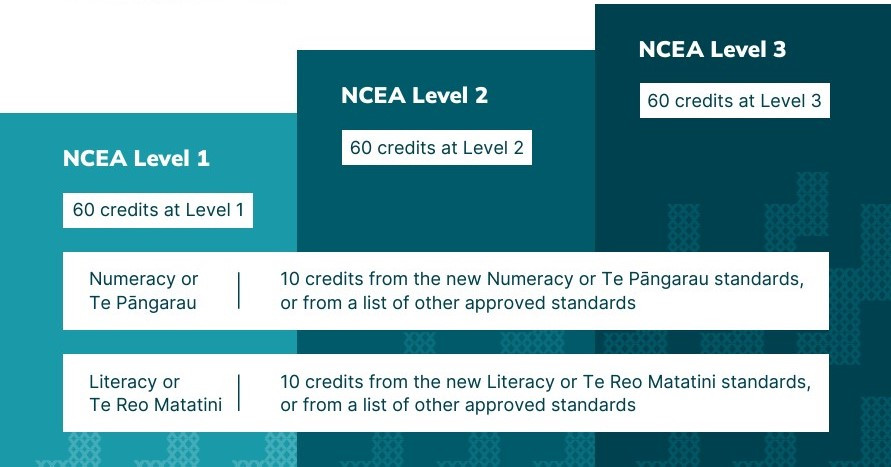
There are three levels of NCEA certificate, depending on the difficulty of the standards achieved. For each level, students need to achieve 60 credits at that level or above, plus 10 Literacy or Te Reo Matatini credits and 10 Numeracy or Te Pāngarau credits.
The 20-credit Literacy and Numeracy or Te Reo Matatini and Te Pāngarau requirement only needs to be met once. After this requirement has been met, it counts for every level of NCEA.
Students can earn the credits required for each level of NCEA over more than one year.
Assessment Types
Internal and external assessment explained
Some standards taught in schools are assessed externally, while others are assessed internally. Internally assessed standards are marked by teachers at school, while externally assessed standards are marked by the New Zealand Qualifications Authority.
Some external assessments are completed through examinations at the end of the year. Other standards are assessed through portfolios or kete manarua, reports, investigations, common assessment activities or tūmahi aromatawai pātahi, or performances.
Resubmissions and Reassessments
Opportunities to demonstrate learning
A resubmission may be offered to individually identified students so they can correct a minor error and gain the grade of Achieved. A resubmission does not allow students to gain Merit or Excellence.
Resubmissions should take place as soon as possible after the assessment has been completed and may be offered when the teacher judges the student should be capable of discovering and correcting the minor error independently.
A resit involves starting a completely new assessment for the standard. This must be offered to the whole class.
Authenticity and Assessment
Ensuring fairness and integrity
Students must ensure that all work submitted for assessment is their own. Artificial intelligence tools may be used to assist learning, but their use must be referenced in the bibliography.
The school uses similarity-checking tools such as Turnitin, Brisk and teacher checkpoints to reduce plagiarism.
When a student is in breach of New Zealand Qualifications Authority rules regarding an assessment, the Principal’s Nominee, Francois Coetzee, will investigate, collect evidence and make an appropriate decision. Students are able to appeal a grade or plagiarism decision through the appeal process.
Senior Learning
Exams, timetables and study support
2026 Grading Examination Timetable (Do not print - LIVE document subject to change)
View the 2026 NCEA examination timetable.
Download the Orewa College examination study guide.
Visit the New Zealand Qualifications Authority website for more information about NCEA.
Useful Links
Forms, policies and appeals
Read the assessment extension and late submission policy.
Contact
Find out more about NCEA, assessment and exams at Orewa College
For more information about NCEA, assessments and examinations, please contact:
Deputy Principal: Francois Coetzee
Email: [email protected]